


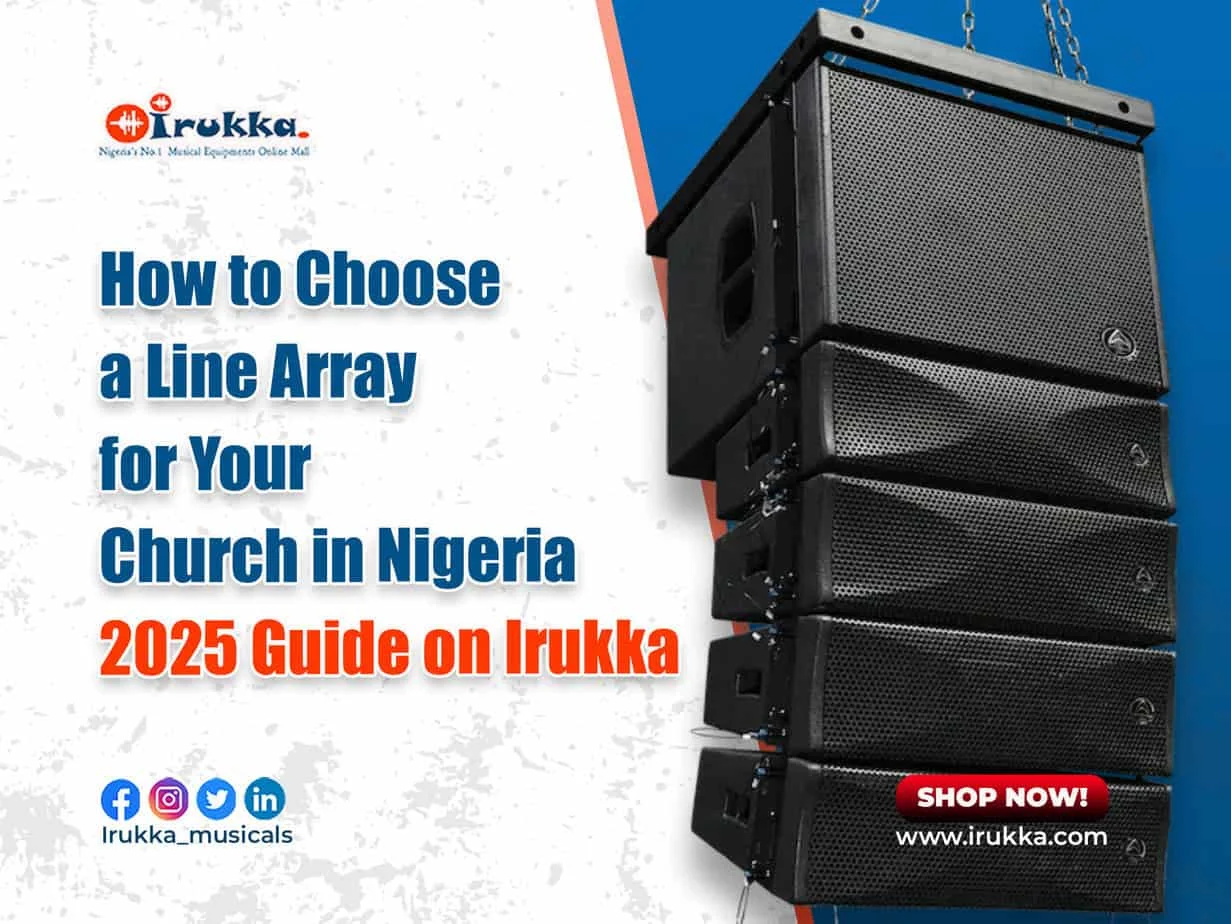
A Practical Buyer’s Roadmap Featuring Wharfedale Systems
If you’re in charge of sound at a church in Nigeria — whether a growing worship centre, a modern auditorium or an outdoor crusade venue — one of the biggest decisions you’ll face is choosing the right line array speaker system. A proper line array can dramatically improve coverage, clarity and impact across every seat in the house. As one expert site puts it:
“Line-array speakers … are designed to be put together in a vertical stack and have a narrow vertical coverage angle and a wider horizontal angle.” worshipfacility.com
This guide will walk you through everything you need to consider — sized for the Nigerian context — and highlight some of the top options from Irukka’s catalogue to match your budget and space.
1. Why a Line Array?
What Makes It Different vs Traditional Speakers
In smaller spaces with simple speaker setups, point-source speakers may suffice. But for larger venues, long throw distances or many rows of seats, line arrays become the smarter choice. According to a professional overview:
“Line arrays are made up of multiple modules … by adjusting the physical angle and the amplitude of individual modules, a higher sound level can be projected toward the back of the room than toward the front, resulting in more consistent coverage throughout the space.”
Key benefits:
-
Better consistency of loudness (SPL) from front seats to the back.
-
Narrow vertical dispersion reduces unwanted reflections off ceilings/floors.
-
Often built for larger, more complex spaces — useful for churches that host rallies, concerts or full-band worship.
2. Match Your Venue Size & Shape
Key Questions to Ask
Before selecting a system, gather this data about your space:
-
How many seats or congregation size?
-
How deep is the room (front to back) and what is the ceiling height?
-
Is there a balcony or multiple levels?
-
Will you use outdoor space or indoor only?
-
What is your budget (purchase + installation + cabling + rigging)?
For example: A narrow, deep auditorium with many rows needs more throw and consistent coverage — that often means more modules or a larger line array system. Meanwhile, if your church hall is shallow or has low ceiling, a compact line array module may suffice.
3. Key Technical Features and Specs
What to Compare & Why They Matter
When you evaluate models, focus on:
-
Coverage angle (horizontal x vertical): Wider horizontal covers many seats; narrow vertical helps control reflections.
-
Driver configuration: E.g., two LF drivers, mid driver plus HF driver (3-way) etc. Three-way cabinets often deliver smoother mids and highs but cost more.
-
Throw/Max SPL: How far sound travels and how loud it can get.
-
Active vs Passive vs Bi-Amp: Active line arrays include built-in amplification/DSP, passive require external amps and DSP, which gives more flexibility but more complexity.
-
Rigging & module weight: Vertical stack height matters for throw but also rigging points must support them safely.
-
Weather resistance & build quality: Especially if used outdoors or in humid Nigerian climates.
4. Fit Irukka’s Catalogue — Top Wharfedale Line Array Options
Here are 3 strong picks from Irukka with varying budgets and use-cases:
● Wharfedale WLA-210XF
Designed for outdoor use (weather resistant), dual 10″ LF drivers with top HF driver — great for mid-sized venues, outdoor crusades or churches with mixed indoor/outdoor usage.
https://irukka.com/shop/shop-managemant/recent-products/wharfedale-wla-210xf/
● Wharfedale WLA-28X / WLA-28
Compact but powerful — suitable for churches wanting high fidelity but limited rigging/height. Two-way modules, pleasing price point.
● Wharfedale WLA-312X
Large format, 3-way modules (LF + MF + dual HF) for larger worship centres or event venues, offering premium performance for more demanding installations.
Each of these models works well when installed correctly — and with proper amp pairing, DSP tuning and layout design from Irukka’s team, you’ll unlock their full potential.
https://irukka.com/shop/speakers/wharfedale-wla-312x-line-array-speaker/
5. Budgeting & Future-Proofing
Getting the Most Value
-
Include amps, DSP, cabling, rigging hardware and installation in your budget — the speaker modules are only part of the cost.
-
Consider growth: your congregation may expand, so choose a system with scalability (stack more modules later).
-
Choose gear that holds value: brands like Wharfedale maintain resale value and reliability.
-
Invest in training: having technical know-how for setup, tuning and maintenance avoids poor performance and unnecessary upgrades.
6. Final Steps Before Purchase
Checklist for Your Team / AV Committee
✅ Confirm seating depth, width, ceiling height.
✅ Visit Irukka showroom (if possible) to demo the models.
✅ Ask for simulation or rigging plan based on your venue.
✅ Choose compatible amplifiers — Irukka can pair the likes of MP 2800 MKII etc.
✅ Plan for installation, mounting, alignment, and calibration.
✅ Include post-purchase support: warranty, maintenance, service from Irukka.
✅ Conclusion
Choosing a line array is about matching the right tool to your space and mission. Whether your church is 200-seat or 2,000-seat, outdoor crusade or indoor theatre, the right system — properly installed and supported — will make every voice and worship moment heard clearly.
At Irukka, we’re ready to help you with every step — from demo to delivery to setup and calibration. When you choose from our catalogue of Wharfedale line arrays, you’re choosing market-leading performance paired with Nigerian-specific support.
👉 Ready to begin? Contact us at Irukka and ask about your ideal line array solution for 2025.


