


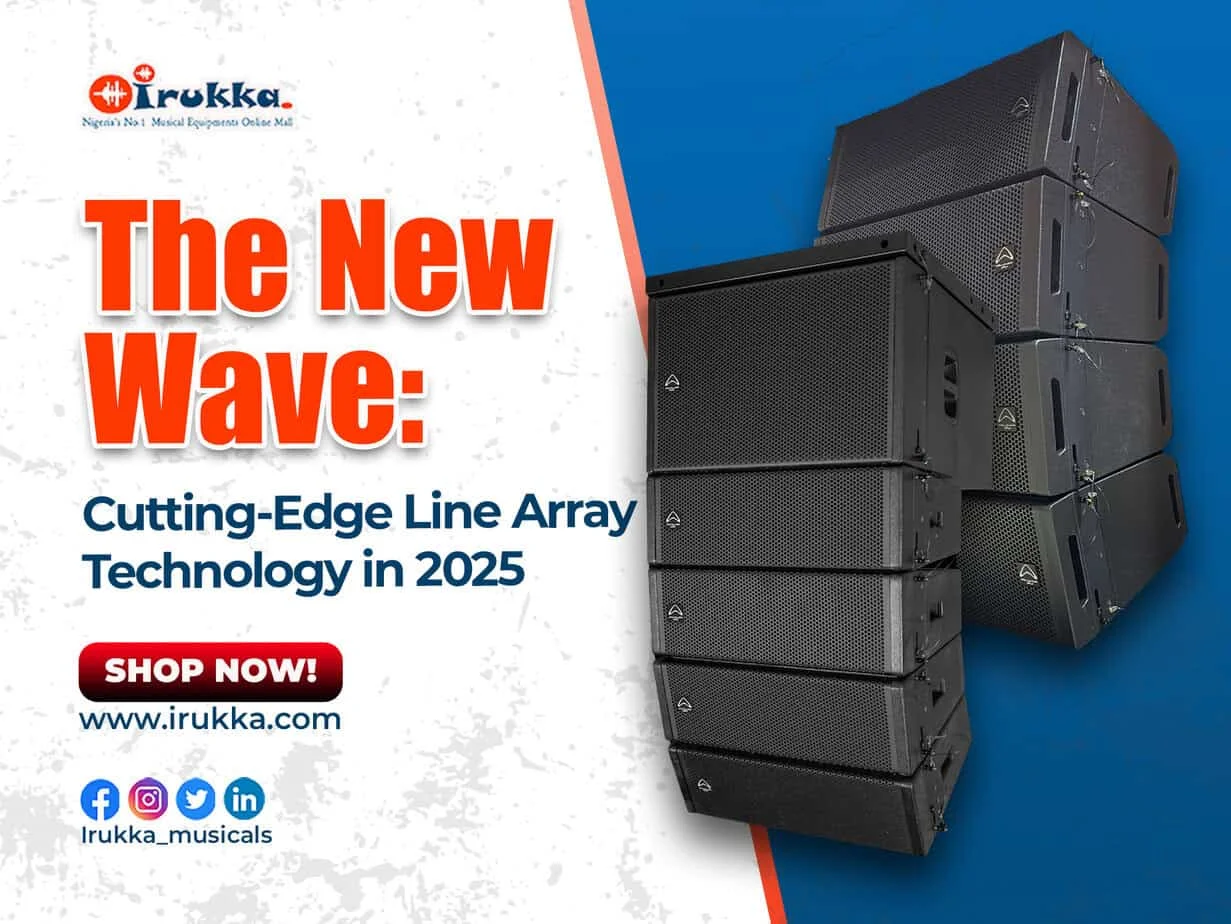
The New Wave: Cutting-Edge Line Array Technology in 2025
As live sound, worship, and large-venue events push the limits of what audiences expect, manufacturers are responding with innovations in line array technology that go beyond raw power. Today it’s not just about louder and stronger — it’s about smarter, cleaner, more adaptable systems. Here are some of the most exciting recent trends in line array tech.
1. Adaptive Directivity & Panflex-Style Waveguides
One of the biggest shifts has been in speaker designs that allow adjustable coverage (horizontal dispersion). Instead of fixed wide or narrow dispersion, new line arrays (like L-Acoustics’ L-Series) use mechanisms that let you switch between patterns (70°, 90°, 110°, symmetric or asymmetric) depending on the venue. This gives you more control over how sound covers the audience, reducing side reflections and improving clarity
These waveguide / Panflex modules allow you to adapt the coverage without needing different boxes for different venue sizes. Less weight, fewer boxes, more flexibility.
2. Smart Amplification and DSP Integration
Modern line arrays increasingly include onboard DSP (Digital Signal Processing) and smart amplification. Instead of just feeding power into passive drivers, you’re getting systems that do real-time optimization: delay, EQ, phase alignment, limiting, feedback control. All this helps with clarity, protects the system, and ensures consistent performance even in challenging acoustic environments.
For instance, newer large-format systems are built as complete “ecosystems”—the speaker cabinets, amps, DSP modules, rigging hardware, and software tools all designed to work together seamlessly. This makes deployment faster and tuning more precise.
3. Lightweight Materials & Portability Enhancements
Weight and ease of transport are always in demand, especially for touring systems and churches/events that move. The use of neodymium drivers, composite or lighter wood (or hybrid) enclosures, thinner but rigid braces, and lighter rigging hardware is growing.
Speakers that used to be bulky are now manageable by smaller crews, and transportation/logistics costs go down. Also, more weather resistance (IP ratings, waterproofing) is being built in for outdoor events.
4. Matrix / Beamforming & Immersive Sound Field Control
One really futuristic step is the use of beamforming, sound field synthesis, or “matrix arrays.” These are array systems that can steer sound “beams” dynamically, shape where the sound goes and doesn’t go, even create multiple “zones” of sound. HOLOPLOT’s X1 Matrix Array is a good example: it provides 3D beamforming and wave-field synthesis, letting you design sound fields that follow audiences, minimize echo/reflection, and deliver immersive experience.
This technology can reduce unwanted noise spill, improve intelligibility (especially for speech, sermons), and give consistent and uniform sound even in irregular or reverberant spaces. For churches in Nigeria with long auditoriums or balconies, that’s a big plus.
5. Eco-Friendly & Smart Power Efficiency
With rising energy costs, there’s a trend toward more power-efficient amplification, smarter standby/idle modes, and reducing non-essential power draw. Some of the newest line arrays are lighter, but also more efficient in terms of SPL per watt. This means same volume with less energy—and lower running and logistical costs.
Also, as hardware evolves, repairability and modular design matter more: being able to replace modules, drivers, or parts instead of the whole box. Sustains investment over time.
6. Waveguide / Coupling Advances
Line arrays are only as good as how well the modules couple together. New speaker designs are improving how multiple boxes align phase, reduce comb filtering, and preserve fidelity over longer throws. The SIGMA waveguide (in APG’s Uniline Max) is one recent example. It improves coupling behaviour between boxes, allowing more consistent sound over varying angles and audience distances.
Good coupling and precise rigging/design matter a lot when deploying in large halls or outdoor settings. Improper alignment leads to drop-offs, weak coverage, or muddy mid / high frequencies.
What This Means for Nigeria & Churches / Live Events
If you’re installing or upgrading a sound system:
-
You don’t always need the biggest boxes as long as the array covers your audience well via adjustable directivity and beamforming.
-
Investing in digital DSP and smart control pays off: less tweaking, better clarity, fewer complaints.
-
Consider portability, weather resistance, and efficiency—you’ll save cost and stress.
-
Focus on rigging, alignment, and coupling when deploying line arrays for best performance.
Final Thoughts: Where Line Arrays Are Heading
The future of line arrays is about precision, adaptability, and immersive sound. Less about brute force and more about delivering intelligible, high-quality sound that adapts to the space, maximizes efficiency, and gives listeners an immersive experience.
If you’re planning a new rig, an upgrade, or a touring setup, those are the specs to watch: adjustable dispersion, beamforming/matrix tech, lightweight but rugged build, efficient power, and serious DSP tools.
Check out the latest line array systems on Irukka Online >>>


